Exaim
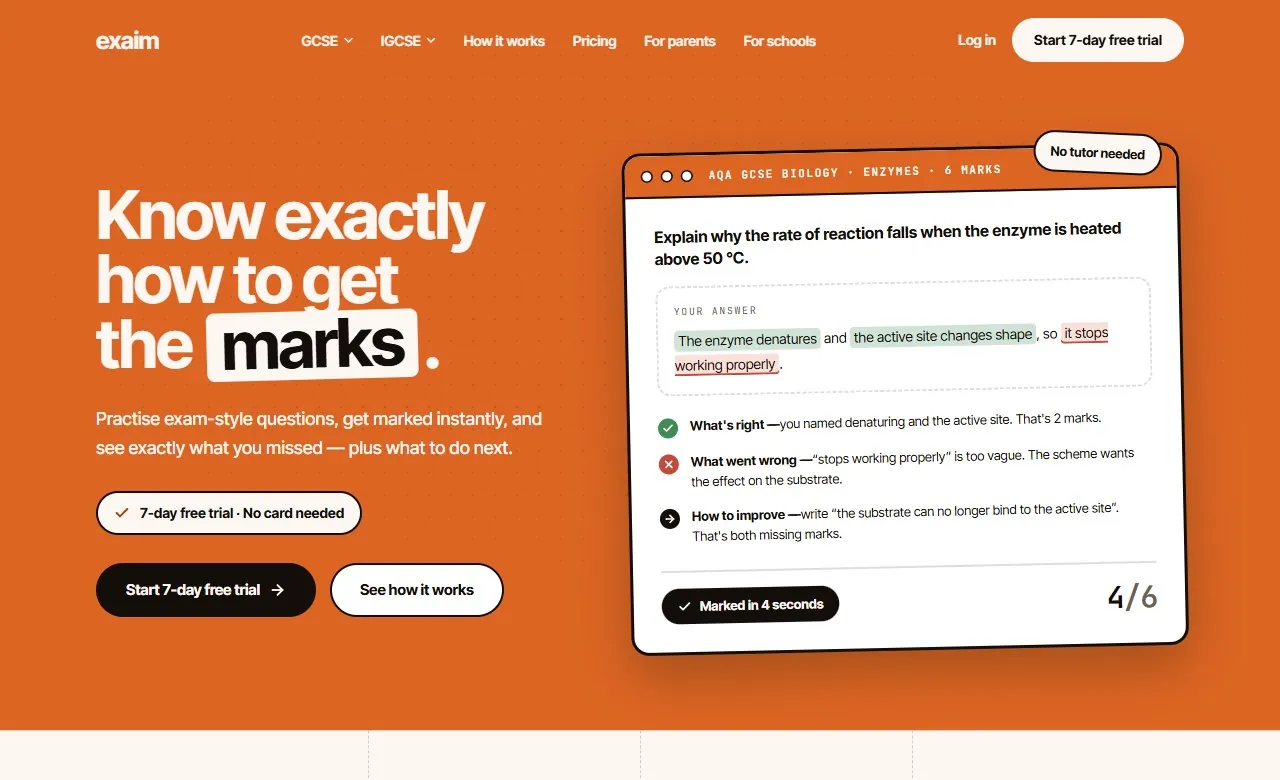
Exaim marks a student's exam answer the way an examiner would — against the actual mark scheme, point by point, in seconds. I took it from a first idea and a PRD all the way to 5,000+ students across 20+ schools, and built the direct-to-student app myself.
The problem
Students practise past papers endlessly but rarely learn why they lose marks. A model answer shows what a perfect response looks like — it doesn't tell you which specific marks your answer earned, which it missed, or the exact wording that would have earned them.
Teachers can mark to that level of detail, but not at the volume a revising student needs. For a class of 30, marking one assignment can eat an entire evening — time that should go into teaching.
Approach & decisions
I started with research, not code: interviews with teachers and students, then wireframes and a full PRD that briefed a development agency to build the first school-facing platform. Through every sprint I was the client-side product lead — testing, validating, and directing fixes until it was production-ready. Then I taught myself to code and built the direct-to-student app end to end.
The course, fed in
The student's answer
Handwritten & drawn work is read by a vision model first.
Marking intelligence layer
Judges the answer against the actual course — not the model's general knowledge
Point-by-point marking
Marks won · marks missed · the exact wording that earns each
Reject the generic AI grader
The obvious build is a chatbot that reads an answer and returns a grade; we tried that thinking and threw it out, because a general model doesn't know an exam board's rules and marks on vibes instead of the scheme. Instead I built a marking intelligence layer fed the exam spec, the marking and assessment guidelines, the topic and subtopic breakdown, and the mark points of the course — so every answer is judged against the actual course. Feedback comes back point-by-point: what's right, what went wrong, and the wording that earns each missing mark.
Meet students where they answer
Exaim handles typed, handwritten, and drawn answers across Biology, Chemistry, Physics and Maths and four boards (AQA, Edexcel, Cambridge, Oxford AQA). Handwritten and drawn work is read by Anthropic vision models and then run through the same intelligence layer. Writing maths on a screen was its own hard problem, so I built a custom LaTeX-based keyboard that lets students enter text and mathematical notation cleanly.
One codebase, two audiences
I built the direct-to-student app so it's also deployable by schools — a single product serving both B2C learners and B2B institutions instead of two divergent builds.
The hard part
The failure mode I had to kill was generic marking. Early on the AI gave plausible-sounding feedback that didn't map to how marks are actually awarded — and a single wrong mark destroys a student's trust in every mark after it.
Two things fixed it. First, the intelligence layer: by grounding every judgement in the real spec, guidelines and mark points, marking stopped being the model's opinion and started tracking the scheme. Second, validation — over four years we ran answers past real examiners and teachers to check what it got right and wrong, and tuned until it held up. It's now vetted by teachers, and that's the part they trust.
Outcome
Marking a class set of 30 by hand can cost a teacher hours; Exaim marks the same set in a minute or two — point by point against the scheme — so teachers spend their time teaching, not grading. Alongside the marking engine I built the analytics dashboards and a gradebook that show students and teachers exactly where marks are being won and lost.
5,000+ students across 20+ schools, with live pilots, a paying B2B school, and B2C running alongside. Exaim has been showcased at GITEX Global, GESS Education and the Dubai Future Innovation Summit, and is in adoption talks with one of Dubai's largest school networks.